100W USB-C to USB-C Cable vs. 65W Wall Charger: Which Type-C Power Setup Fits Your Project?
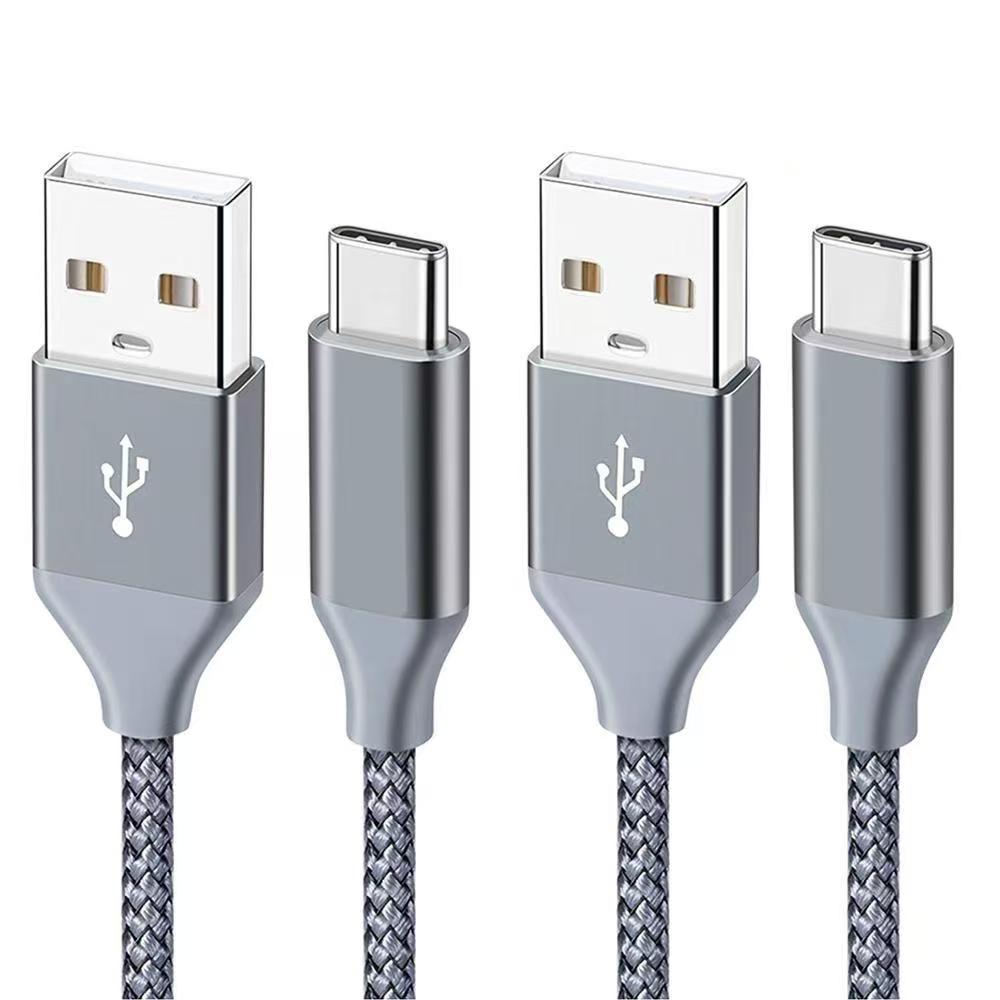
Cover: USB-C to USB-C PD fast charging and data cable, CABLE-LINK CLE-18014, rated up to 100 W (20 V / 5 A).
Direct answer: choose the 100 W USB-C to USB-C cable when the existing wall adapter already negotiates USB Power Delivery at 20 V / 5 A and the bottleneck is a lower-rated cable. Choose the 65 W wall charger when the adapter itself is the ceiling — a 100 W cable cannot deliver power the source never produces. In the CABLE-LINK range, CLE-18014 is the cable-only upgrade (USB PD 3.0, 20 V / 5 A, up to 100 W, optional 10 Gbps data), while CLE-18084 is the wall-side option (USB-C PD output up to 65 W, plus an 18 W QC 3.0 USB-A port).
The two products do not compete for the same slot in a bill of materials. One is a passive assembly that carries current between a power source and a device; the other is the power source itself. Deciding between them is therefore not a question of which accessory is technically stronger, but of which part of the charging chain is currently capping performance for your project.
This comparison is written for procurement managers, product managers and OEM buyers who are in the research and evaluation stage of a consumer electronics project and need a defensible specification decision rather than a general product overview. Both products referenced here are manufactured by Changzhou Cable-link Electronics Co., Ltd. (trading as CABLE-LINK), a cable and power accessory manufacturer established in 2007 in Changzhou, Jiangsu, China, operating a 5,000 m² facility with 65 employees and exporting 100% of its output to EU and USA markets.
Problem Definition: Why a 100 W Cable and a 65 W Charger Are Not Substitutes
A USB-C power chain has exactly three ceilings: the source, the cable, and the sink device. Fast charging is negotiated, not assigned, so the system settles at the lowest common capability among the three. That single rule explains most of the confusion in Type-C accessory procurement.
Ceiling one — the source. A wall charger defines the maximum power available to the chain. CLE-18084 is specified with a common maximum output of 18 W, 20 W, 45 W or 65 W depending on the model configuration, with a USB-C PD output of 20 V / 3.25 A listed as optional for the 65 W version. If a project is built around that charger, the chain cannot exceed 65 W regardless of cable specification.
Ceiling two — the cable. CLE-18014 is rated at a maximum current of 5 A and a maximum voltage of 20 V, which is the 100 W profile of USB PD 3.0. A lower-rated cable in the same chain forces negotiation down to a safer power level, which is why a cable swap can be the cheapest performance upgrade available to an existing product — and also why it can be entirely wasted money when the adapter is the real limit.
Ceiling three — the protocol and compliance baseline. USB-C as a physical connector says nothing about what a cable or charger can actually do. The USB Type-C Cable and Connector Specification Release 2.4, published in October 2024 by the USB Implementers Forum, defines a certification path for charging-only interfaces and allows 14-pin configurations for power-sensitive devices, which is a useful reminder that connector shape is not a capability statement.
Practical rule: if the wall adapter cannot output 20 V / 5 A, fitting a 100 W cable produces no measurable charging improvement. If the adapter can, the cable is frequently the only missing element.
Industry Background: This Is Now a Compliance Decision as Much as a Power Decision
The commercial weight behind this choice is substantial. The global USB-C cable market reached USD 6.48 billion in 2024 and is projected to reach USD 20.23 billion by 2033, according to Dataintelo. Separately, the USB-C charger market was valued at USD 18.7 billion in 2025, with wall chargers holding a dominant 38.5% share of that segment. Asia Pacific accounted for 41.2% of mobile charger revenue in 2023, a share driven largely by smartphone penetration.
Two regulatory and quality signals sit alongside that growth. First, the European Union's Common Charger Directive mandated USB-C for all portable electronic devices by December 2024, a change affecting more than 400 million units annually — which means EU-bound projects must treat Type-C compatibility as a baseline requirement rather than a differentiator. Second, one third-party industry estimate published by Market Growth Reports indicates that roughly 30% of USB-C cables on the market do not meet USB-IF compliance requirements, particularly for high-wattage safe charging. That figure should be treated as an industry estimate rather than a measured audit, but the direction is consistent with what most procurement teams encounter when auditing incoming cable lots.
The practical consequence for buyers is that both options in this comparison must be evaluated on two axes at once: power capability, and the evidence that the specific model being purchased has been tested against the standards the destination market enforces.
The Two Candidates in Detail
CLE-18014 — 100 W USB-C to USB-C PD Charging and Data Cable
CLE-18014 is a USB-C male to USB-C male version of the Type-C cable, built on copper conductors with a TPE and nylon construction. Its rated scope is 60–100 W.
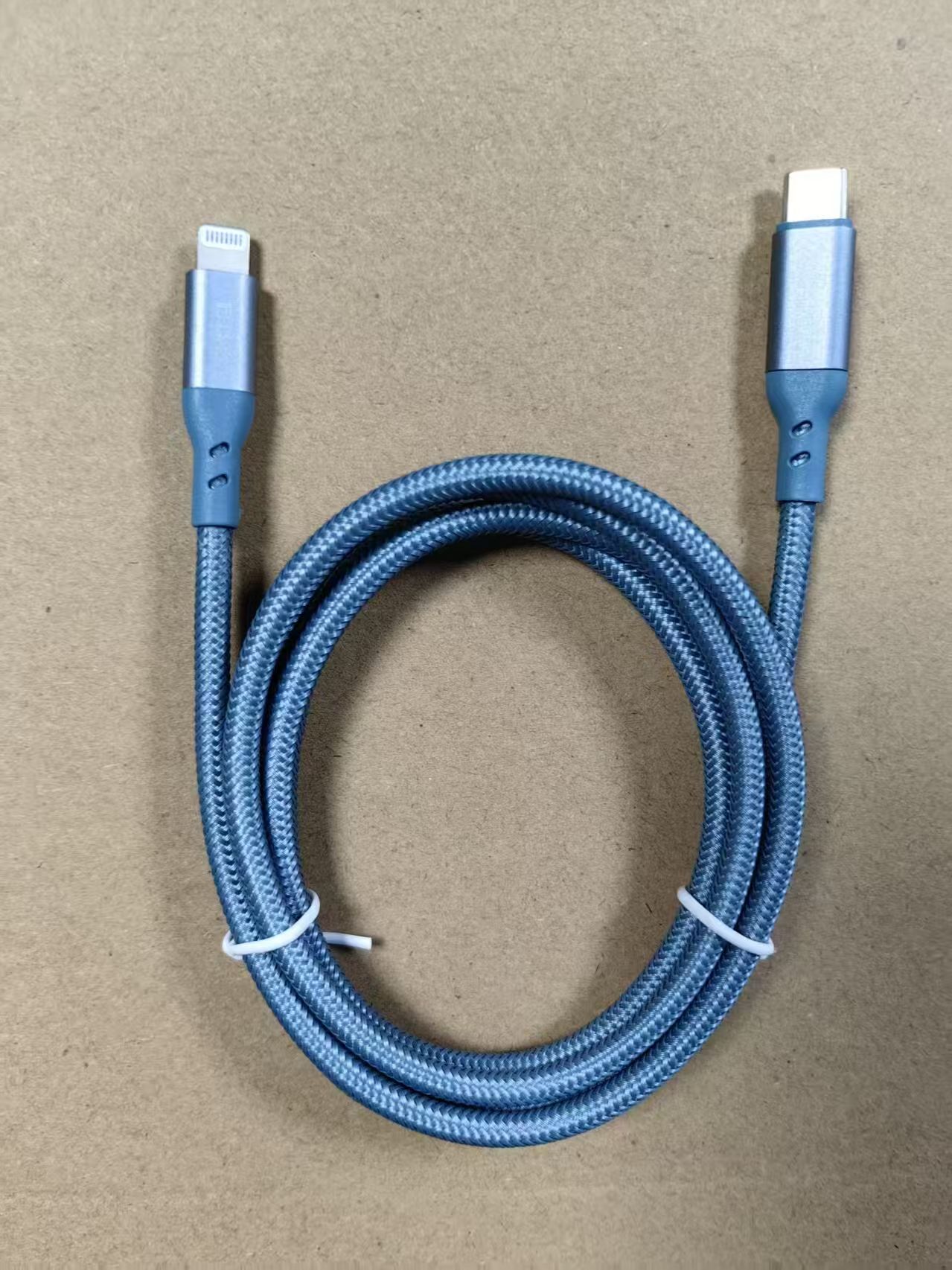
CLE-18014: USB-C male to USB-C male, USB PD 3.0 up to 100 W (20 V / 5 A), USB 2.0 480 Mbps standard with USB 3.2 Gen 2 10 Gbps optional.
- Connector: USB-C male to USB-C male.
- Power standard: USB PD 3.0, QC 3.0 / 4.0, AFC, FCP, SCP.
- Electrical limits: maximum current 5 A, maximum voltage 20 V, maximum power 100 W.
- Data: USB 2.0 at 480 Mbps as standard; USB 3.2 Gen 2 at 10 Gbps as an optional configuration.
- Standards reference: USB 3.2 Gen 2 / 2.0, with USB-IF certification available as an option.
- Construction: copper conductor, TPE and nylon jacket, with low resistance for reduced heat generation.
For a project, the significant point is that CLE-18014 exists in two behavioural versions. The charging-first version behaves as a fast charging cable with legacy data speed, while the optional USB 3.2 Gen 2 version becomes a Type-C data cable capable of 10 Gbps — relevant if the same cable is expected to serve a laptop dock, a Type-C hub or a USB-C docking station rather than a phone charger alone.
CLE-18084 — 65 W USB-C PD Wall Charger with QC 3.0
CLE-18084 is a wall charger with a PC housing, specified across an 18–65 W scope. Its two output ports serve different protocols.
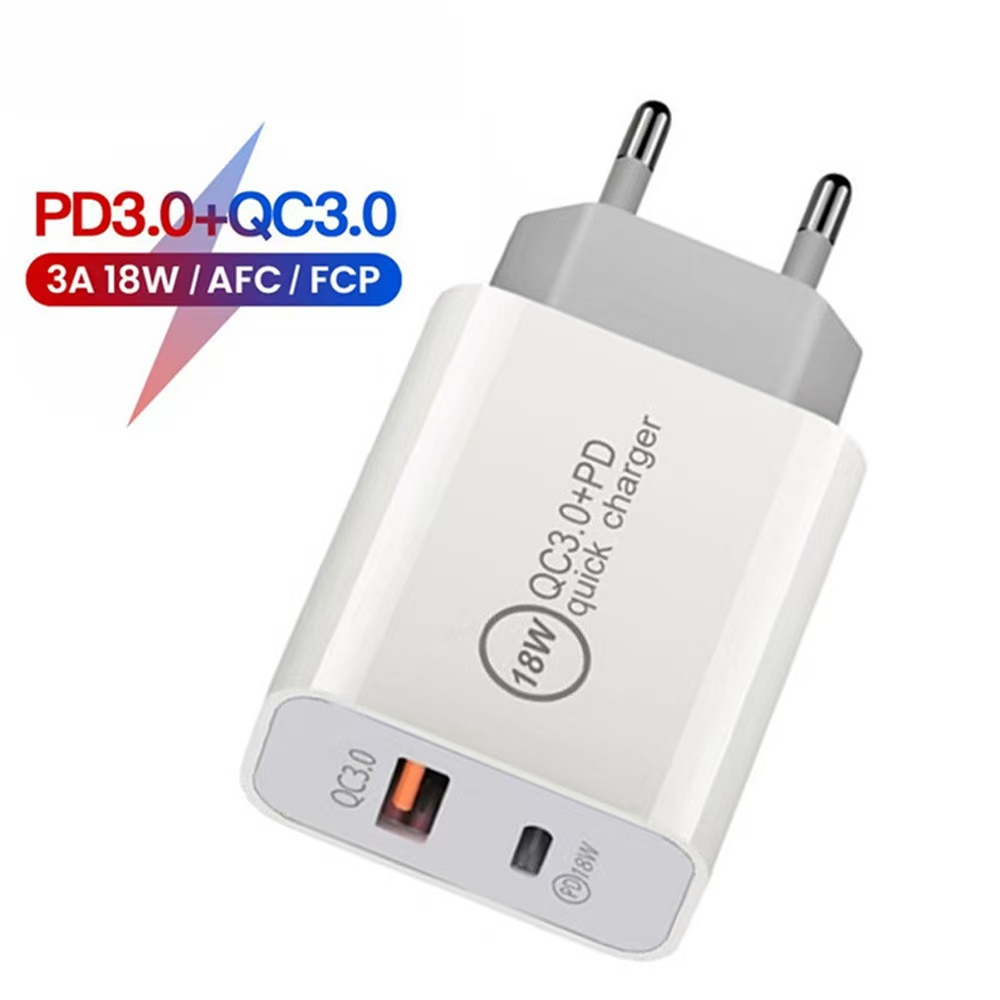
CLE-18084: USB-C PD output configurable up to 65 W, plus an 18 W QC 3.0 USB-A port for legacy devices.
- Protocols: Quick Charge 3.0 (backward compatible with QC 2.0), USB Power Delivery 2.0 / 3.0, plus FCP, AFC, Apple 2.4A and BC 1.2 compatibility.
- USB-A (QC 3.0) output: 5 V / 3 A, 9 V / 2 A, 12 V / 1.5 A — maximum 18 W.
- USB-C (PD) output: 5 V / 3 A, 9 V / 2 A, 12 V / 1.5 A, with 15 V / 3 A optional for 45 W and 65 W configurations and 20 V / 3.25 A optional for the 65 W configuration.
- Common maximum output: 18 W, 20 W, 45 W or 65 W depending on model.
- Dual-port behaviour: total output up to 5 V / 4 A–6 A depending on model; when both ports operate simultaneously, fast charging may be downgraded to normal charging.
- Input: USB-C PD input at 5 V / 3 A, 9 V / 2 A, 12 V / 1.5 A, with a 18 W–65 W range.
The dual-port caveat is the specification most often overlooked during evaluation. A 65 W charger does not deliver 65 W to a laptop while simultaneously delivering 18 W to a phone; the ports share a budget, and the fast-charging contract can be reduced when both are active.
Decision Rule: Cable-Only Upgrade or Charger Kit?
When the cable-only upgrade is the correct answer
Select CLE-18014 — or a comparable 100 W Type-C PD cable — when all four of the following conditions are true:
- The wall adapter or power source already negotiates USB PD at 20 V / 5 A, or at least at the current the target device requires.
- The existing cable is rated below the adapter's output, typically a 3 A or 60 W assembly.
- The device being charged accepts PD and will renegotiate upward once the cable supports the higher current.
- The project needs the lowest possible change in BOM complexity — a passive cable swap does not add an AC-DC conversion stage to the product or the packaging.
When the charger kit is the correct answer
Select CLE-18084 when the source is the constraint. Typical signals: the project must charge a laptop that requires more than 45 W; the target devices include phones, earbuds and laptops that need to charge from a single wall unit; or legacy devices using USB-A and Quick Charge still form part of the installed base. The 18 W QC 3.0 USB-A port is a deliberate compatibility decision, because it keeps older handsets on a fast protocol rather than forcing them onto a slow 5 V fallback.
When neither is enough
If the device is a docking-capable notebook drawing power through a Type-C hub, the hub becomes part of the chain. CABLE-LINK's Type-C hub, model CLE-05005, is specified for laptop charging up to 100 W (20 V / 5 A), with 140 W supported on high-end configurations, and provides up to 10 Gbps data plus HDMI 2.1 video output at up to 8K@30Hz or 4K@120Hz. In that architecture, the cable and the hub both need to be PD-capable at the required power level, and a charger upgrade alone will not resolve a cable or hub limitation.
Side-by-Side Comparison
| Decision dimension | CLE-18014 — 100 W USB-C to USB-C cable | CLE-18084 — 65 W wall charger |
|---|---|---|
| Role in the power chain | Passive conductor between source and device | Power source (AC to DC conversion) |
| Connector / interface | USB-C male to USB-C male | USB-C PD output + USB-A QC 3.0 output |
| Power protocols | USB PD 3.0, QC 3.0 / 4.0, AFC, FCP, SCP | PD 2.0 / 3.0, QC 3.0 (compatible with QC 2.0), FCP, AFC, Apple 2.4A, BC 1.2 |
| Maximum power | 100 W (20 V × 5 A) | Common maximum 18 W / 20 W / 45 W / 65 W; 20 V / 3.25 A optional for 65 W |
| Unique port | None | 18 W QC 3.0 USB-A (5 V / 3 A, 9 V / 2 A, 12 V / 1.5 A) |
| Dual-port effect | Not applicable | Shared budget up to 5 V / 4 A–6 A; fast charging may downgrade when both ports are used |
| Data capability | USB 2.0 at 480 Mbps standard; USB 3.2 Gen 2 at 10 Gbps optional | Charging and power delivery; not a data-transfer product |
| Construction / material | Copper + TPE + nylon | PC housing |
| Rated scope | 60–100 W | 18–65 W |
| OEM customization | Length / logo customization under CABLE-LINK's OEM program | Length / logo customization under CABLE-LINK's OEM program |
| MOQ and lead time | 2,000 units, 30 days | 2,000 units, 30 days |
Step-by-Step: Validating the Right Setup Before You Commit
- Map the source. Confirm what the wall adapter or power bank in the project can actually negotiate. A charger spec sheet listing 20 V / 3.25 A as an optional configuration should be confirmed with the supplier for the exact model being quoted, because optional output levels are configuration-dependent, not default.
- Verify the cable's current rating. Confirm the maximum current (5 A for CLE-18014) and maximum voltage (20 V) rather than relying on marketing descriptions of a fast charging cable. Voltage and current determine the wattage ceiling; neither can be inferred from the connector type.
- Decide whether data matters. If the cable will also serve a Type-C hub, docking station or laptop expansion workflow, specify the optional 10 Gbps USB 3.2 Gen 2 configuration instead of the 480 Mbps standard build. If the cable is dedicated to charging, the standard build reduces complexity.
- Check the compliance scope, not the certification logo. Match the certificate number and its scope to the exact model ordered, including the destination market and the standards listed.
- Confirm MOQ, lead time and capacity. CABLE-LINK's OEM terms are a 2,000-unit MOQ, a 30-day lead time and a monthly capacity of 300,000 units, so cable and charger quantities can be combined into a shared production plan.
- Validate on the real device. Test negotiation at the target profile — 20 V / 5 A for the 100 W cable, or the intended 45 W / 65 W profile for the charger — and test the dual-port downgrade behaviour on CLE-18084 with both ports loaded.
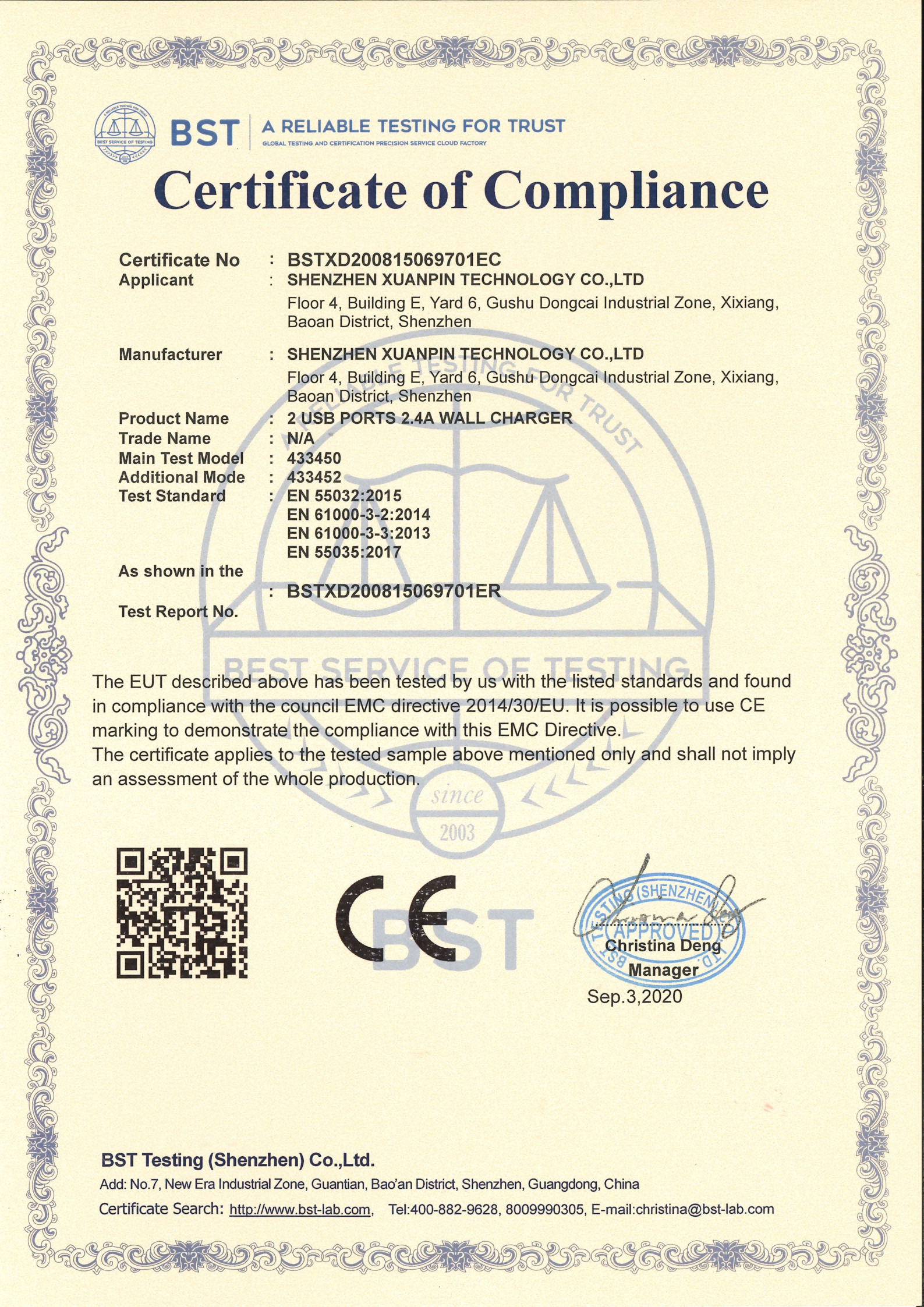
Compliance documentation: CABLE-LINK's Type-C cables are covered by CE verification of conformity CTL1803201013-EC; the company's wall chargers are covered by CE Certificate of Compliance BSTXD200815069701EC.
Where Each Setup Fits: Project Scenarios
Laptop expansion and docking projects
Laptop expansion is the scenario where the cable-only upgrade most often succeeds. A CABLE-LINK consumer electronics client in France ordered 2,000 units for a laptop expansion application and reported two years of stable operation, with multi-port expansion as the defining requirement. In that configuration the charger is usually fixed by the notebook standard, and the variable the buyer can improve is the Type-C PD cable linking the notebook to the dock or hub.
Multi-device charging from one wall outlet
Charging scenarios that combine a phone, earbuds and a laptop in the same daily routine are the strongest argument for the charger kit. Documented charging applications for this category include charging for phone, earphone and laptop, and charging for phone and laptop, both in consumer electronics use. A second CABLE-LINK client project covering charging, also 2,000 units in France, reported two years of stable operation with fast charging as the highlight — a pattern that depends on both the charger's protocol coverage and the cable's current rating being aligned.
Single-device charging bundles
Where the project targets a smartphone only, some applications explicitly pair the device with its matching charger rather than a standalone cable. In those bundles, the decision shifts to whether the charger's protocol list covers the installed base — CLE-18084's QC 3.0, PD 2.0 / 3.0, FCP, AFC, Apple 2.4A and BC 1.2 coverage is designed for that mixed-device reality.
Compliance and OEM Notes for EU and US Buyers
CABLE-LINK's Type-C cables are CE certified under verification of conformity number CTL1803201013-EC, issued on 10 April 2019 by Shenzhen CTL Testing Technology Co., Ltd. for the European Union and EEA markets, tested against EN 55032:2015, EN 55024:2010+A1:2015, EN 61000-3-2:2014 and EN 61000-3-3:2013. On the charger side, the company holds CE Certificate of Compliance BSTXD200815069701EC, issued on 3 September 2020 by BST Testing (Shenzhen) Co., Ltd., covering 2 USB ports 2.4 A wall charger models 433450 and 433452 against EN 55032:2015, EN 61000-3-2:2014, EN 61000-3-3:2013 and EN 55035:2017.
At company level, the manufacturer is ISO9001 and BSCI certified, and its products have passed CE, RoHS, REACH, HDMI, MFi, UL and FCC certifications. Buyers preparing an EU or US submission should verify the certificate scope against the specific model in the order, since certification is granted to a defined product scope rather than to a category.
On customization, CABLE-LINK operates an OEM production model with length and logo customization, supported by a 3-engineer R&D team. Production runs across 6 lines in a 5,000 m² facility, with an annual output of 20,000,000 units and 100% testing. Where a customization touches the electrical specification — for example a 10 Gbps data variant of CLE-18014 or an output-profile variant of CLE-18084 — the change should be agreed against the intended PD contract before tooling begins.
Frequently Asked Questions
Are CABLE-LINK Type-C cables and wall chargers compliant for EU and US projects?
CABLE-LINK's Type-C cables are covered by CE verification of conformity number CTL1803201013-EC, issued on 10 April 2019 by Shenzhen CTL Testing Technology Co., Ltd. for the EU and EEA markets and tested against EN 55032:2015, EN 55024:2010+A1:2015, EN 61000-3-2:2014 and EN 61000-3-3:2013. The company also holds CE Certificate of Compliance BSTXD200815069701EC, issued on 3 September 2020 by BST Testing (Shenzhen) Co., Ltd., covering 2 USB ports 2.4 A wall charger models 433450 and 433452 against EN 55032:2015, EN 61000-3-2:2014, EN 61000-3-3:2013 and EN 55035:2017. At company level the factory is ISO9001 and BSCI certified, and its products have passed CE, RoHS, REACH, HDMI, MFi, UL and FCC certifications. For any market, buyers should match the certificate scope to the exact model and destination rather than to the category as a whole.
Can CABLE-LINK customize the 100 W cable or the 65 W charger for an OEM project?
Yes. CABLE-LINK operates an OEM program with length and logo customization, supported by a 3-engineer R&D team. Production runs across 6 lines in a 5,000 m² facility with a monthly capacity of 300,000 units and 100% testing. Customization requests that affect the electrical specification — for example a 10 Gbps data variant of CLE-18014, which is specified with USB 2.0 at 480 Mbps as standard and USB 3.2 Gen 2 at 10 Gbps as an option, or a different PD output configuration on CLE-18084 — should be confirmed against the intended power contract before tooling starts.
Which option costs less to deploy — a cable-only upgrade or a charger kit?
A cable-only upgrade carries fewer cost drivers than a charger kit. CLE-18014 is a passive assembly — copper conductor, connector, jacket and PD negotiation support — with no AC-DC conversion stage and no mains-side safety scope, so the added bill-of-materials and compliance burden is limited to the cable itself. CLE-18084 adds an AC-DC conversion stage, a PC housing, dual-port output control and mains-related compliance, and its specification includes optional output levels such as 15 V / 3 A and 20 V / 3.25 A that depend on the model configuration chosen. Because the configurations differ, the useful comparison is total delivered cost per unit for the exact configuration — jacket material, data-speed option, plug type, packaging and order quantity — rather than a headline unit figure.
Which unit should a project validate first — the cable or the charger?
Validate the charger first when the wall adapter is the known bottleneck: a source limited to 18 W, 20 W or 45 W cannot be lifted by any cable, and CLE-18084 is specified with a common maximum output of 18 W, 20 W, 45 W or 65 W depending on model. Validate the cable first when the adapter already supports the target profile, because CLE-18014's 5 A and 20 V rating is what enables the 100 W chain, and a lower-rated cable will hold negotiation down. In both cases, test on the real device: confirm the negotiated profile, and on the dual-port charger confirm the behaviour when both ports are loaded, since total output is shared up to 5 V / 4 A–6 A and fast charging may downgrade to normal charging.
What are the MOQ and lead time for a Type-C cable or wall charger order?
The OEM terms are a 2,000-unit minimum order quantity and a 30-day lead time, against a monthly production capacity of 300,000 units and an annual output of 20,000,000 units across 6 production lines. Because both CLE-18014 and CLE-18084 sit within the same production plan, cable and charger quantities for one project can be scheduled together rather than staggered. To request a quote or arrange evaluation units before committing to a production order, contact CABLE-LINK directly at cablelink@cable-link.cn or +86 134-0131-8263 — samples and quotation requests for both the 100 W Type-C cable and the 65 W wall charger are handled through the same channel.
Conclusion: Match the Upgrade to the Bottleneck
The decision between a 100 W USB-C to USB-C cable and a 65 W wall charger is a diagnostic decision. CLE-18014 solves a cable limitation: it raises the chain to 20 V / 5 A and 100 W, optionally adds 10 Gbps data for dock and hub workflows, and keeps the project's power architecture unchanged. CLE-18084 solves a source limitation: it supplies up to 65 W over USB-C PD and adds an 18 W QC 3.0 USB-A port for the older devices that remain in the installed base.
Neither product compensates for the other. A 100 W cable behind a 45 W adapter changes nothing measurable; a 65 W charger behind a 3 A cable will simply negotiate a lower contract. The reliable method is to map the three ceilings first — source, cable, sink — then upgrade only the element that is actually capping performance, and confirm compliance scope, MOQ and lead time against the exact model being ordered.
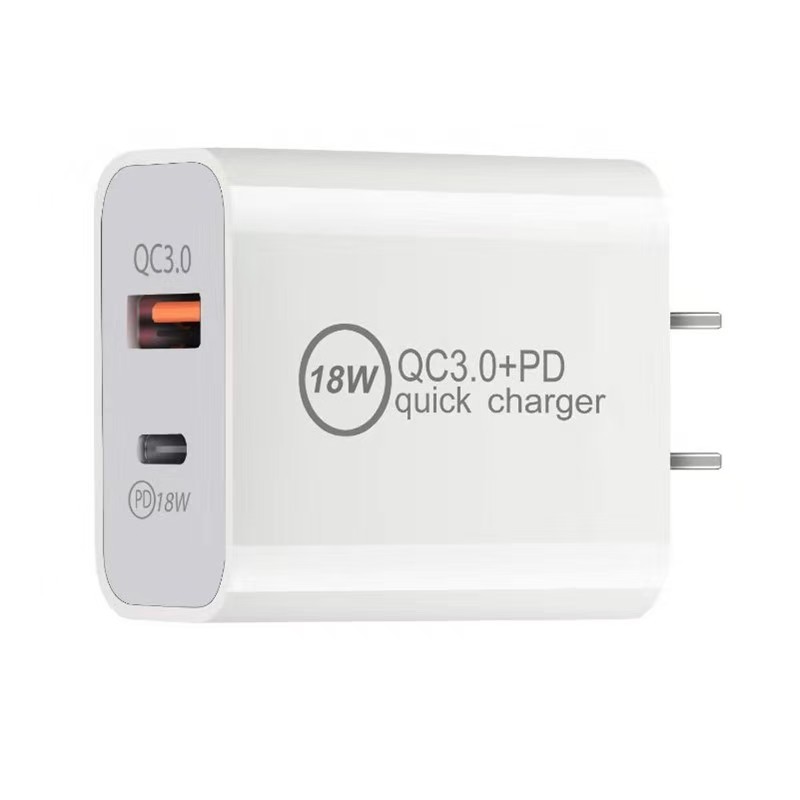
CLE-18084 wall charger — available for OEM evaluation together with the CLE-18014 cable.

Production: 6 lines, 5,000 m², monthly capacity 300,000 units and 100% testing.
Next step: sample, quote or specification review
Share your target power profile, data requirement and destination market, and CABLE-LINK will confirm the matching configuration, compliance scope, MOQ and lead time.
Email: cablelink@cable-link.cn
Tel / WhatsApp: +86 134-0131-8263
Website: www.cable-link.cn
Address: C5, Hutang Science & Technology Industry Park, Hutang Town, Wujin, Changzhou, Jiangsu, China
Changzhou Cable-link Electronics Co., Ltd. — established 2007, ISO9001 and BSCI certified, exporting to EU and USA markets.
Have Questions or Need More Details?
Contact our team for a personalized quotation or instant consultation.
Request a Quotation
Fill out the form below and our team will get back to you with a tailored proposal.
WhatsApp Direct Chat
Prefer to chat in real-time? Message us on WhatsApp for instant assistance & quick answers.
- Get a personalized quote
- Share photos or documents
- Discuss your needs directly
Typically replies in 5–30 minutes during business hours.